Mara Epuraș, maternal home worker: Change does not depend on how big you are, but on how much you care / March for Life Bucharest 2026
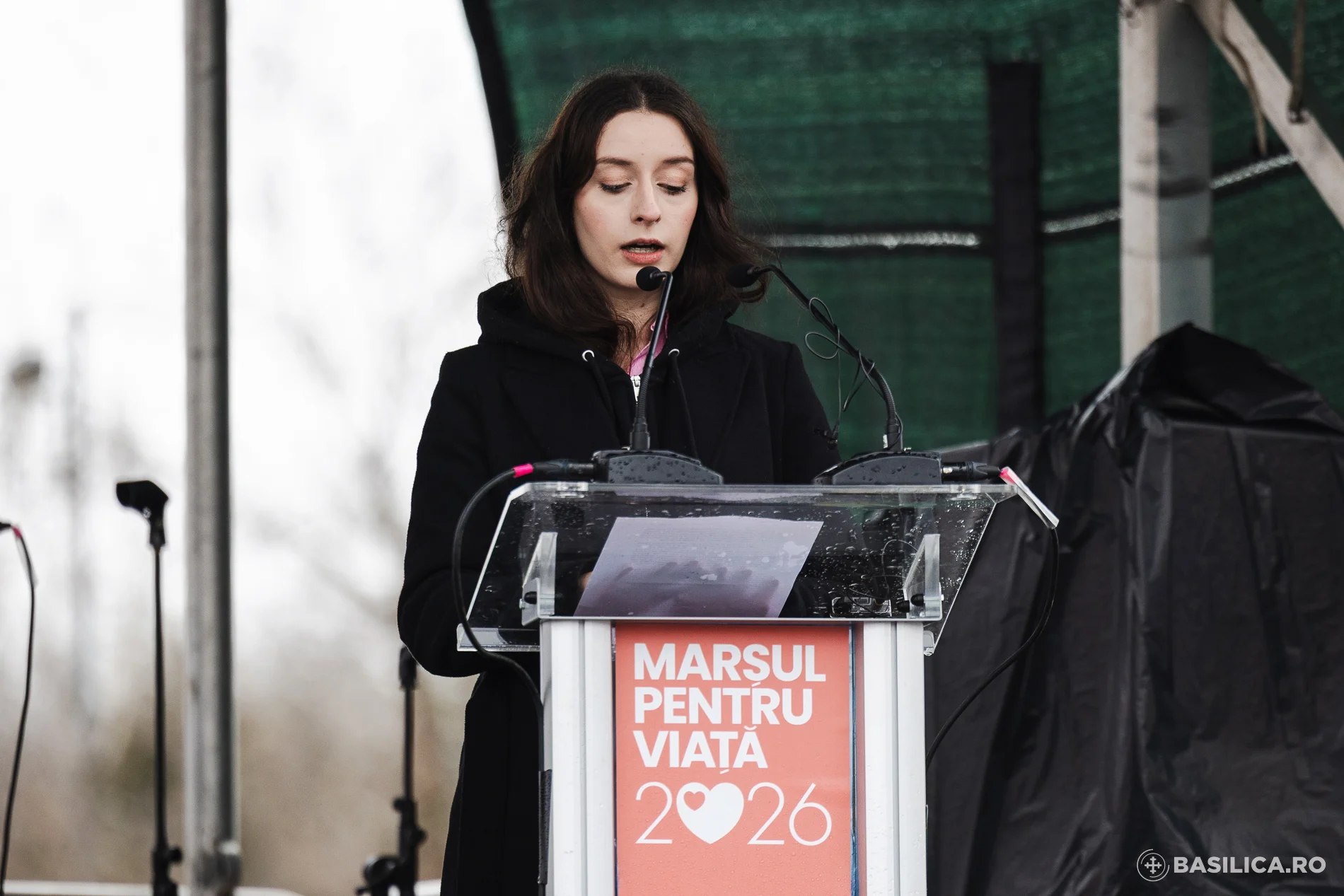
Mara Epuraș, worker in a maternal home from Romania, spoke ar the March for Life Bucharest 2026:
Have you ever thought about what it feels like to have nowhere to return home to… not because you don’t want to, but because fear is waiting for you there?
As I have mentioned before, I work as a social worker at the Saint Helena Maternal Center in Valea Lupului, Iași County. It is a place that proves that even a small community can do something great: it can save lives. Mothers in crisis come here—pregnant women without support, mothers with children fleeing abusive and fear-filled relationships, women who simply no longer have a place to live. And most of the time, they arrive not only without a roof over their heads… they arrive without trust, without safety, without hope.
I met a 33-year-old mother with four children. She lived in abuse for 11 years. When she arrived at our center, she was insecure, frightened, and at times it was difficult even for her to communicate. She was the kind of person who apologized… even when she had done nothing wrong. But, for the first time, she was no longer alone.
We stood by her—through the divorce process, in the fight for her children’s rights, in the search for rental housing, even though few landlords are willing to accept a family with four children. We were there in the small things, too: when she had to take her children to school, to the doctor, or simply when she needed someone to encourage her not to give up. It was hard.
But it was possible. Today, she lives in a rented home with her children, supports herself, works, manages on her own… and, perhaps most importantly, she has she has regained self-confidence. This is one of the few cases with such a good ending. And that is exactly why it matters so much. Because it shows us that change is possible… when someone is there at the right time.
From our experience working with mothers in crisis, we have learned a simple truth: a mother does not need only a roof over her head. She needs people. She needs specialists, a community, real support, and a safe place where she can begin to rebuild her life. Through support, counseling, concrete assistance, and guidance, their perspective begins to change.
They begin to believe in themselves, they begin to see that there is an alternative for the future, and, perhaps most importantly, they begin to feel that they are no longer alone. And that changes everything. This is what solidarity truly means—the solidarity we are speaking about today: not only saying that we stand for life, but truly standing beside it where it is most difficult.
The Saint Helena Center offers exactly this: counseling, support, safety, and a real chance for a new beginning. But such places do not exist on their own. They exist because people choose not to remain indifferent—through volunteering, through donations, through involvement. If we relate this to the theme of the March for Life, this is what real solidarity with the mother and her child means, not only at the level of words. It means standing not only with the unborn child, but also beside the fears, traumas, and uncertainties of a mother. It means offering support where there is vulnerability.
In Valea Lupului, we have proven that this is possible. A small community has managed to build and sustain a functional maternal center. This shows that change does not depend on how big you are, but on how much you care. That is why, if we truly want to stand beside the mother and the child, we need more: more support, more centers like this, and more people willing to get involved. Because solidarity is not a slogan, but a choice we make every day.
And perhaps this is what ultimately remains: life is not defended only through words, but through what we choose to do for it every day—through how we respond when someone needs help, through the courage not to pass by indifferently. Because sometimes, for a mother, the difference between despair and hope is not a speech… but a person who chose to be there.
Related Posts
-
 Monica Radu, in a wheelchair, mother of three children, The March for Life 2019: “Here is the joy of celebrating life”
-
 Romanian Orthodox Bishop’s Christmas encyclical on children: “I beseech you not to tear away the flowers planted by God”
-
 Voices for Life / “For Life” magazine – Spring 2016
-
 Margaret Hartshorn: a lifetime of serving Life / “For Life” magazine – Spring 2016